Immunotherapy
Why Risankizumab Works Across Skin, Joint, and Gut Disease
Not every useful paper needs to introduce a brand-new mechanism. Sometimes the most helpful thing is a clean synthesis that explains why a drug makes sense across several diseases at once. That is what this risankizumab mini-review is doing. It gathers mechanism of action, PK/PD, immunogenicity, and trial data into one place and makes the development logic of IL-23 blockade much easier to see.
The Problem
Psoriasis, psoriatic arthritis, and Crohn’s disease look very different at the organ level, but they overlap immunologically in ways that matter for drug development. IL-23 and the Th17 axis sit close to the center of that overlap. The challenge, though, is not just showing that IL-23 matters. It is showing that a specific antibody, given at a specific dose and interval, produces the right downstream biologic effects without introducing obvious exposure-dependent safety tradeoffs.
Background Science
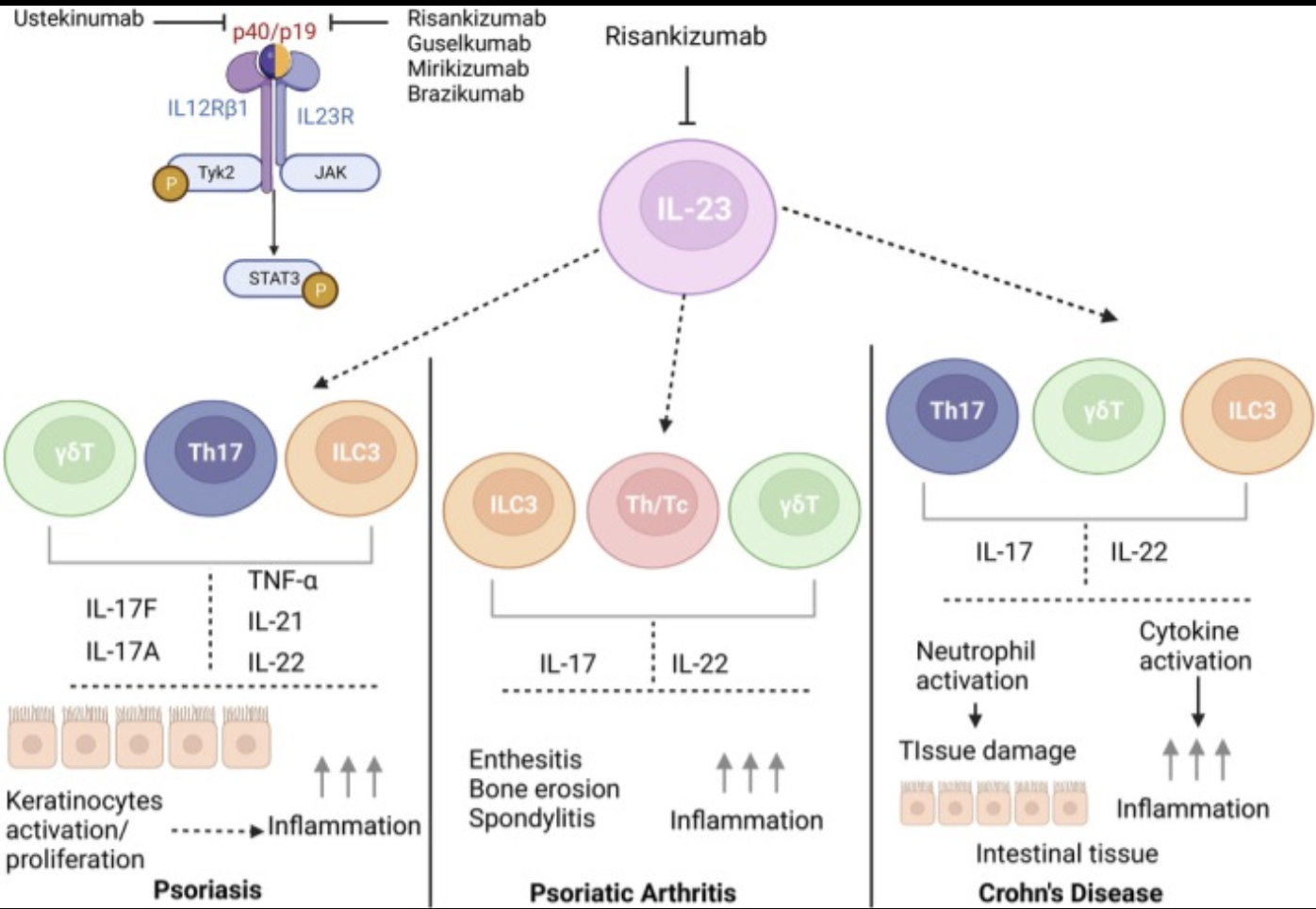
Risankizumab is a high-affinity neutralizing human IgG1 antibody that binds the p19 subunit of IL-23 and does not bind IL-12, which shares the p40 subunit with IL-23. That distinction is important because the drug is trying to block the IL-23 pathway specifically rather than shutting down a broader cytokine axis. The review’s mechanistic figure does a nice job of showing why that matters across tissues: in psoriasis, IL-23 supports pathogenic Th17 programs linked to IL-17 and IL-22 production; in psoriatic arthritis, related signaling connects to inflammation, enthesitis, and bone pathology; and in Crohn’s disease, IL-23-related pathways involve Th17 cells, γδ T cells, and ILC3s in the gut. The PK story is also clean. Across indications, risankizumab shows linear, time-independent PK consistent with a typical IgG1 monoclonal antibody, with estimated systemic clearance of 0.31 L/day, steady-state volume of distribution of 11.2 L, and a terminal half-life around 28 days in a typical psoriasis patient, with somewhat faster clearance and a roughly 21-day half-life in Crohn’s disease.
What They Did
Because this is a mini-review, the “what they did” section is really a synthesis exercise. The authors compile regulatory approval history, dosing, population PK, exposure-response analyses, pharmacodynamic biomarker studies, immunogenicity, and pivotal efficacy/safety data. They walk through why 150 mg subcutaneous dosing at weeks 0 and 4 and then every 12 weeks was selected for psoriasis and psoriatic arthritis, and why Crohn’s disease uses 600 mg intravenous induction at weeks 0, 4, and 8 followed by subcutaneous maintenance. They also summarize covariate analyses such as body weight, serum albumin, and anti-drug antibodies.
What’s New?
What feels most useful here is not novelty in the bench-science sense, but integration. The review shows how one drug program is stitched together from multiple translational layers. In psoriasis, risankizumab was statistically superior to placebo, ustekinumab, adalimumab, and methotrexate on PASI90 and sPGA 0/1 outcomes in pivotal studies. In psoriatic arthritis, phase 3 trials showed superiority over placebo for ACR20 at week 24, with efficacy maintained through week 52. In Crohn’s disease, induction studies met co-primary end points of clinical remission and endoscopic response, and maintenance studies met co-primary end points of CDAI clinical remission and endoscopic response versus placebo withdrawal. On the biomarker side, the review summarizes reductions in serum IL-17A, IL-17F, IL-6, and BD-2 in PsA, and decreases in IL-22, fecal calprotectin, and CRP in Crohn’s disease.
My Interpretation
What I enjoyed about this paper is that it makes risankizumab feel like more than just “another cytokine antibody.” It shows how mechanism, exposure, biomarker behavior, and clinical outcome can actually line up. That is satisfying from a translational point of view. Still, I would not mistake this paper for an independent systematic review. It is a sponsor-authored mini-review, and that matters. The goal here is clearly to present the internal coherence of the risankizumab program, not to stress-test it against every competing interpretation or every other IL-23 blocker. That does not make it unhelpful. It just tells you how to read it.
What I’d Do Next
I would like to see a more directly comparative translational analysis across the p19 inhibitors, especially around tissue-specific biomarkers, nonresponse, and reasons to switch. I would also want better predictors of who actually needs higher maintenance intensity in Crohn’s disease and who is already sitting on the efficacy plateau in psoriasis or psoriatic arthritis. The PK and exposure-response sections make clear that more drug is not automatically better, which means precision in escalation becomes really important.
Something I Learned
This paper reminded me how much invisible quantitative reasoning is baked into what looks, from the outside, like a simple dosing schedule. It is easy to see “150 mg every 12 weeks” and think that the regimen is just a practical clinical choice. But underneath that are exposure-response curves, plateau effects, biomarker shifts, covariates, and a bunch of assumptions about what level of pathway suppression is enough. I liked seeing that logic made explicit.
My Favorite Figure
References
- Pang Y, D’Cunha R, Winzenborg I, et al. Risankizumab: Mechanism of Action, Clinical and Translational Science. Clinical and Translational Science. 2024.