Immunotherapy
The Cancer-Immunity Cycle: a New Way to Think About Immunotherapy
Some papers are important because of one killer experiment. Others are important because they give the field a map. The Chen and Mellman paper is firmly in the second category. It lays out the cancer-immunity cycle, a framework that breaks antitumor immunity into a sequence of steps and, in doing so, makes the whole field easier to think about.
The Problem
Immunotherapy can feel fragmented if you learn it one result at a time.
Checkpoint blockade seems to be about inhibitory receptors. Vaccines are about antigens. CAR T is about engineered targeting. Dendritic-cell biology is about priming. Tumor vasculature is about trafficking. Tregs and myeloid cells are about suppression.
All of that is true, but without a unifying framework it becomes hard to see how the pieces relate. The problem this paper solves is organizational: how do we place all of these mechanisms into one coherent model of antitumor immunity?
Background Science
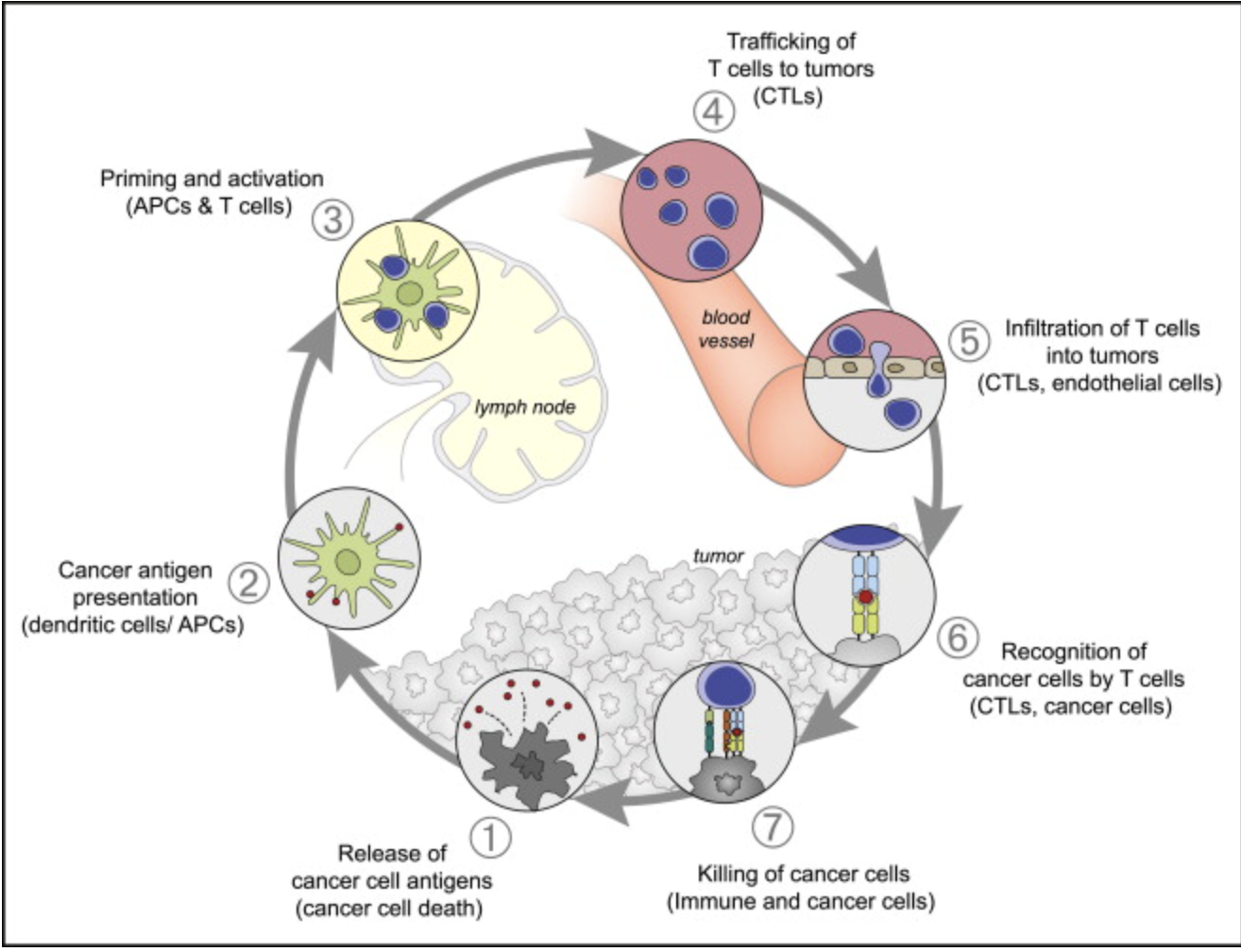
At a broad level, the immune system needs to do several things to control cancer. Tumor antigens have to be released. Antigen-presenting cells have to process and present them. T cells need to be primed and expanded. Those effector cells then have to traffic to the tumor, infiltrate it, recognize malignant cells, and kill them. Killing should then release more tumor antigen and restart the loop.
That is the cycle.
What makes the Chen and Mellman framing powerful is that every failed immunotherapy response can now be interpreted as a breakdown at one or more of those steps.
What They Did
This is a conceptual paper, so “what they did” is less about bench experiments and more about synthesis.
They integrated immunology, cancer biology, and emerging immunotherapy data to formalize the cancer-immunity cycle as a series of stepwise events. Each step can be productive or blocked. Each therapeutic class can then be understood according to which point in the cycle it helps restore.
That sounds simple, but the value is enormous. It converts a messy field into something closer to a systems map. Once you have that map, you can start to think rationally about combinations.
What’s New?
The novelty is the framework itself.
This paper gave the field a language for saying not only that a tumor is resistant, but how it is resistant. Is antigen release poor? Is priming defective? Are T cells unable to traffic? Are they excluded from the parenchyma? Are they present but inhibited? Are they metabolically unfit?
That structure is the reason this paper aged so well. It does not solve every mechanistic problem, but it tells you where in the process the problem probably lives.
My Interpretation
I think this is one of the most useful non-primary-style papers a person interested in immunotherapy can read.
It is easy to get lost in the latest molecules and combinations. This paper pulls back and reminds you that most therapies are trying to rescue one or more points in the same basic loop.
I also think it makes combinations make more sense. Combination therapy is not exciting just because “two things are better than one.” It is exciting when the two things repair different broken steps in the cycle. A vaccine plus checkpoint blockade makes sense because one can improve priming and the other can relieve inhibition. A trafficking intervention plus metabolic engineering makes sense because getting T cells into a tumor is not the same as keeping them functional there.
That is why this framework still matters. It helps you think mechanistically before you think fashionably.
What I’d Do Next
If I were updating this paper today, I would build metabolism explicitly into the cycle.
The original framework absolutely still works, but the field now better appreciates that a T cell can complete the early steps of the cycle and still fail at the tumor because the metabolic environment is too hostile.
I would also add a stronger account of spatial architecture. “Infiltration” is not one thing. Some tumors are inflamed, some are excluded, some are deserts, and that spatial distinction matters a lot.
Finally, I would integrate cell-engineering therapies more directly. CAR T and TCR therapies fit into the cycle, but they also partially bypass steps like endogenous priming. That makes them really interesting stress tests of the framework.
Something I Learned
The biggest lesson from this paper is that good conceptual work can change how you read everything that comes after it.
Once I learned the cycle, immunotherapy papers became easier to place. Instead of reading seven unrelated mechanisms, I started seeing repeated attempts to repair recurring bottlenecks.
That is a pretty valuable feeling, especially in a field as fast and crowded as cancer immunology.
My Favorite Figure
References
- Chen DS, Mellman I. Oncology Meets Immunology: The Cancer-Immunity Cycle. Immunity. 2013.