Immunotherapy
Teaching T Cells to Enter the Part of the Tumor They Usually Miss
A lot of solid-tumor immunotherapy papers assume that if you build a strong enough T cell, the rest will take care of itself. But immune-excluded tumors are a reminder that location is its own bottleneck. A T cell that stays trapped at the tumor edge is not really in the fight. That is why the Allen et al. paper stands out. It is not only about improving T-cell potency. It is about building a local cytokine program that helps T cells actually get into the tumor.
The Problem
One of the most frustrating features of solid tumors is that many are not fully devoid of immune cells. They are excluded. Immune cells can accumulate around the tumor border or surrounding stroma but fail to penetrate deeply into the tumor mass.
That matters especially for engineered T-cell therapy. CAR T cells need proximity. If they cannot efficiently enter the right tissue compartment, antigen recognition and killing become secondary problems.
So the question here is very straightforward: can synthetic biology be used to make T cells establish a local cytokine environment that improves intratumoral entry and function without just dumping inflammatory cytokines systemically?
Background Science
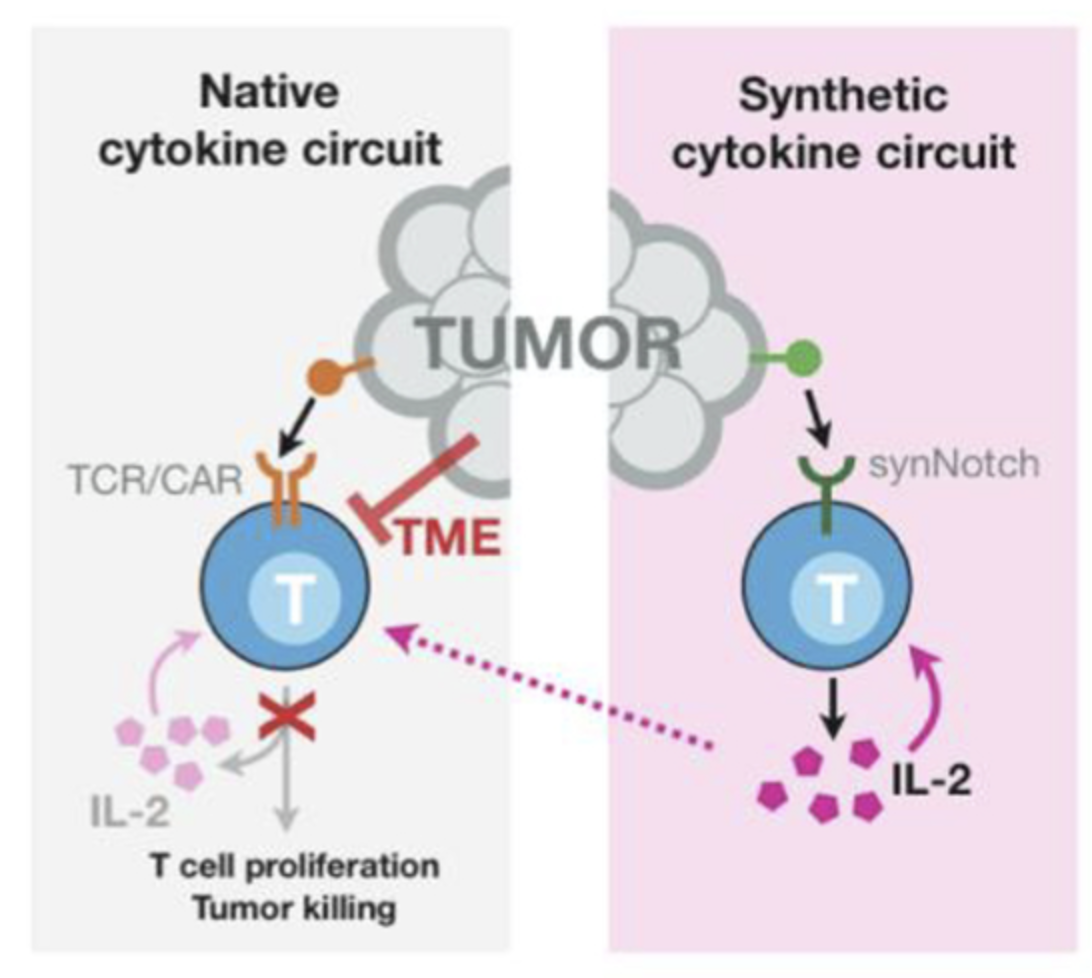
Cytokines are powerful but dangerous tools. Systemic cytokine delivery can activate immune cells broadly, but toxicity becomes a major issue fast. Synthetic circuits offer a way around that by linking cytokine production to a local trigger, usually tumor recognition.
That is a really appealing concept for solid tumors. Instead of giving cytokines everywhere, you let the T cell generate them where they are needed.
The Allen paper fits into that broader idea, but with a sharper problem in mind: immune exclusion.
What They Did
At the highest level, the authors engineered T cells with synthetic cytokine circuits designed to activate local cytokine programs in response to tumor-context cues. The goal was not just to make the cells more inflammatory in general, but to make them more capable of expanding and functioning inside tumors that usually keep them out.
The paper used preclinical solid-tumor systems to examine whether these engineered circuits changed T-cell localization and antitumor activity. The central finding was that they did. The synthetic cytokine programs improved local T-cell accumulation and performance in immune-excluded tumor settings.
I am being slightly cautious here because the exact implementation details are less important for a blog reader than the experimental logic. The core design principle is that tumor-triggered cytokine support can convert a hostile tumor geography into a more permissive one.
What’s New?
The main conceptual advance is that the paper treats tumor entry itself as something you can engineer.
That seems obvious now, but a lot of earlier cell-therapy design focused on recognition and killing. This paper says that even very capable T cells may fail if the tumor architecture keeps them out, and that local cytokine logic can help solve that specific spatial problem.
So the novelty is not only in the synthetic circuit. It is in elevating infiltration from a background variable to a primary engineering target.
My Interpretation
This paper feels important to me because it addresses a problem that has quietly limited a huge amount of solid-tumor work.
People often ask why CAR T has been so much more successful in blood cancers than in solid tumors. Antigen heterogeneity matters. Trafficking matters. Immunosuppression matters. But simple physical access also matters more than I think we sometimes admit.
What I like here is that the solution is not just “make the T cell stronger.” It is “make the T cell smarter about where and when it builds support for itself.”
That is a much better solid-tumor mindset. The best therapy is not always the most aggressive cell. It may be the cell that best adapts to the actual geography of the tumor.
What I’d Do Next
I would want to compare different tumor architectures directly. Do these circuits work equally well in fibrotic pancreatic tumors, desmoplastic ovarian tumors, and more inflamed but still excluded lung lesions?
I would also want long-term safety data. Local cytokine release is attractive because it should reduce systemic toxicity, but synthetic circuits always raise the question of how tight the spatial control really is.
And practically, I would be interested in combining this strategy with metabolic engineering. A T cell that both gets into the tumor and is built to stay metabolically competent there would be much more compelling than either intervention alone.
Something I Learned
This paper reinforced something I keep coming back to in cell therapy: movement is not a secondary property.
We often treat migration as a logistics problem and cytotoxicity as the real biology. But in solid tumors, migration is biology. A cell that cannot penetrate is functionally weaker even if its killing machinery is perfect on paper.
My Favorite Figure
References
- Allen GM, Frankel NW, Reddy A, et al. Synthetic Cytokine Circuits That Drive T Cells into Immune-Excluded Tumors. Science. 2022.