Immunotherapy
When Tumor T Cells Run Out of Power
A lot of papers describe dysfunctional tumor-infiltrating lymphocytes by listing the markers they express. PD-1 is up, Tim-3 is up, cytokines are down, and so on. That is useful, but it can make dysfunction feel like a surface phenotype rather than a cellular state. What I like about the Scharping et al. paper is that it goes underneath those markers and asks whether part of intratumoral dysfunction is really a mitochondrial insufficiency problem.
The Problem
T cells inside solid tumors frequently fail even when they get into the tumor and recognize antigen. One explanation is chronic stimulation. Another is inhibitory signaling. Both are real. But neither fully answers a more basic question: what is physically wrong with these cells?
If the tumor microenvironment is nutrient-poor, suppressive, and chronically inflammatory, then one possibility is that T cells cannot maintain the mitochondrial machinery required for sustained function. If that is true, then dysfunction is not just about being “turned off.” It is about being underbuilt.
Background Science
Mitochondria matter in T cells for more than ATP. They help regulate redox balance, biosynthesis, survival, and long-term persistence. In many immune contexts, better mitochondrial fitness tracks with better durability and functional reserve.
PGC1α is one of the major regulators of mitochondrial biogenesis. So if a tumor environment suppresses PGC1α-linked programs, the cell can lose mitochondrial mass and function over time.
That is an attractive framework because it explains why tumor-infiltrating T cells may still be present but progressively less capable.
What They Did
The authors examined tumor-infiltrating T cells and compared them with more functional T-cell populations. They assessed mitochondrial content and function, transcriptional features related to mitochondrial biogenesis, and the role of signaling pathways that might repress these programs inside tumors.
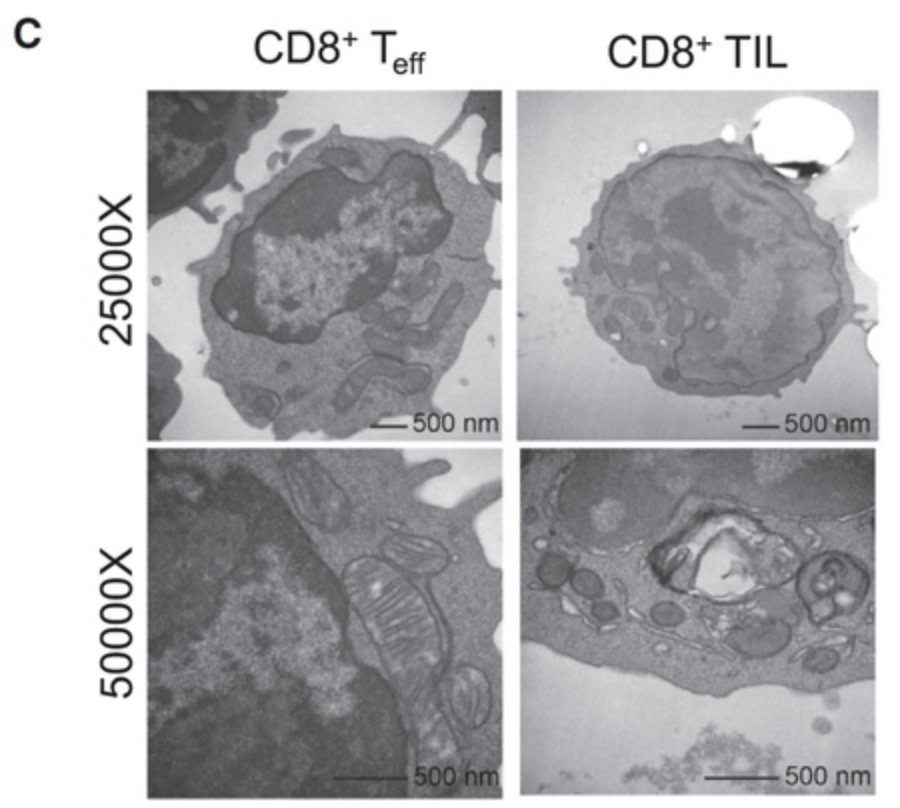
A major takeaway was that intratumoral T cells showed reduced mitochondrial biogenesis and metabolic capacity. The paper connected this state to signaling circuitry that suppresses PGC1α-associated programs.
Then the authors did the experiment you would want them to do: they forced expression of PGC1α in T cells. That intervention improved mitochondrial attributes and enhanced antitumor performance in their models.
Again, the logic is satisfying. Not just “here is a defect,” but “here is a causal lever.”
What’s New?
The key advance is that this paper reframes T-cell dysfunction in tumors as partly a failure of organelle maintenance.
That may sound almost too simple, but I think it is important. When immune cells are discussed in tumors, we often focus on transcription factors, checkpoints, and cytokines. This paper says that one reason those downstream failures happen is that the cell never maintains the mitochondrial program needed to sustain high-quality function.
That is a different kind of intervention point. It suggests that future immunotherapy might need to preserve cellular infrastructure, not only relieve inhibition.
My Interpretation
This paper matches a way of thinking about cell therapy that I find really compelling: receptor design is not enough.
You can engineer specificity beautifully. You can build a great CAR. You can optimize recognition, co-stimulation, trafficking, or cytokine secretion. But if the cell cannot maintain its own energetic machinery inside the tumor, all of that engineering starts to matter less over time.
That is why I think this paper still feels modern. It points toward a broader engineering philosophy where persistence, mitochondrial quality, and metabolic resilience are treated as first-class design variables.
I also think it helps make “exhaustion” a more useful word. Exhaustion sometimes gets used like a vague label for anything bad that happens to a T cell. This paper gives it more physical meaning. At least part of what we call exhaustion may be a collapse in mitochondrial support.
What I’d Do Next
I would want to test whether mitochondrial rescue strategies synergize with checkpoint blockade, cytokine engineering, or altered CAR signaling domains.
I would also want to know how durable PGC1α-driven rescue really is. Does it improve function transiently, or does it fundamentally change the fate of the T cell once it is in the tumor?
And because solid tumors differ so much metabolically, I would want to compare contexts. A hypoxic pancreatic tumor may stress T cells differently from a melanoma or lung tumor. Mitochondrial insufficiency may be a common theme, but the exact failure mode could still vary.
Something I Learned
What I learned most from this paper is that organelle biology can be immunotherapy biology.
That sounds obvious in hindsight, but I think people, including me, sometimes mentally separate those areas. Mitochondria feel like cell biology, while T-cell dysfunction feels like immunology. This paper is a good reminder that those are the same problem once you are inside a tumor.
My Favorite Figure
References
-
Scharping NE, Menk AV, Moreci RS, Whetstone RD, Dadey RE, Watkins SC, et al. The Tumor Microenvironment Represses T Cell Mitochondrial Biogenesis to Drive Intratumoral T Cell Metabolic Insufficiency and Dysfunction. Immunity. 2016.
-
Bengsch B, Johnson AL, Kurachi M, Odorizzi PM, Pauken KE, Attanasio J, et al. Bioenergetic Insufficiencies Due to Metabolic Alterations Regulated by the Inhibitory Receptor PD-1 Are an Early Driver of CD8+ T Cell Exhaustion. Immunity. 2016.
-
Menk AV, Scharping NE, Moreci RS, Zeng X, Guy C, Salvatore S, et al. Early TCR Signaling Induces Rapid Aerobic Glycolysis Enabling Distinct Acute T Cell Effector Functions. Cell Reports. 2018.