Immunotherapy
Metabolites Can Act Like Checkpoints
There are a lot of metabolism papers that end up saying some version of the same thing: activated immune cells need energy. That is true, but it is also vague. What I like about the Ho et al. paper is that it gets more specific. Instead of treating metabolism as a broad background condition, it argues that a particular metabolite, phosphoenolpyruvate or PEP, behaves almost like a checkpoint for antitumor T-cell function.
The Problem
T cells inside tumors often become dysfunctional, especially in nutrient-poor environments. The common interpretation is that low nutrients just mean less ATP and therefore less overall cellular performance.
But that explanation is incomplete. Cells do not only use metabolites to make energy. Some metabolites reshape signaling directly. That means a low-nutrient state might not just make a T cell tired. It could actively distort the signaling pathways that determine whether the T cell stays functional.
The central question here is whether that is happening in antitumor T cells.
Background Science
PEP sits in glycolysis near the end of the pathway. In biochemistry class, it is usually introduced as an intermediate on the way to pyruvate. But metabolites like that can matter for more than flux.
T-cell activation depends heavily on calcium signaling and downstream transcriptional programs such as NFAT. If nutrient deprivation disrupts the machinery controlling intracellular calcium, then the cell’s functional program can fall apart even before it literally runs out of ATP.
That is what makes this paper clever. It asks whether one glycolytic metabolite is doing signaling work, not just energetic work.
What They Did
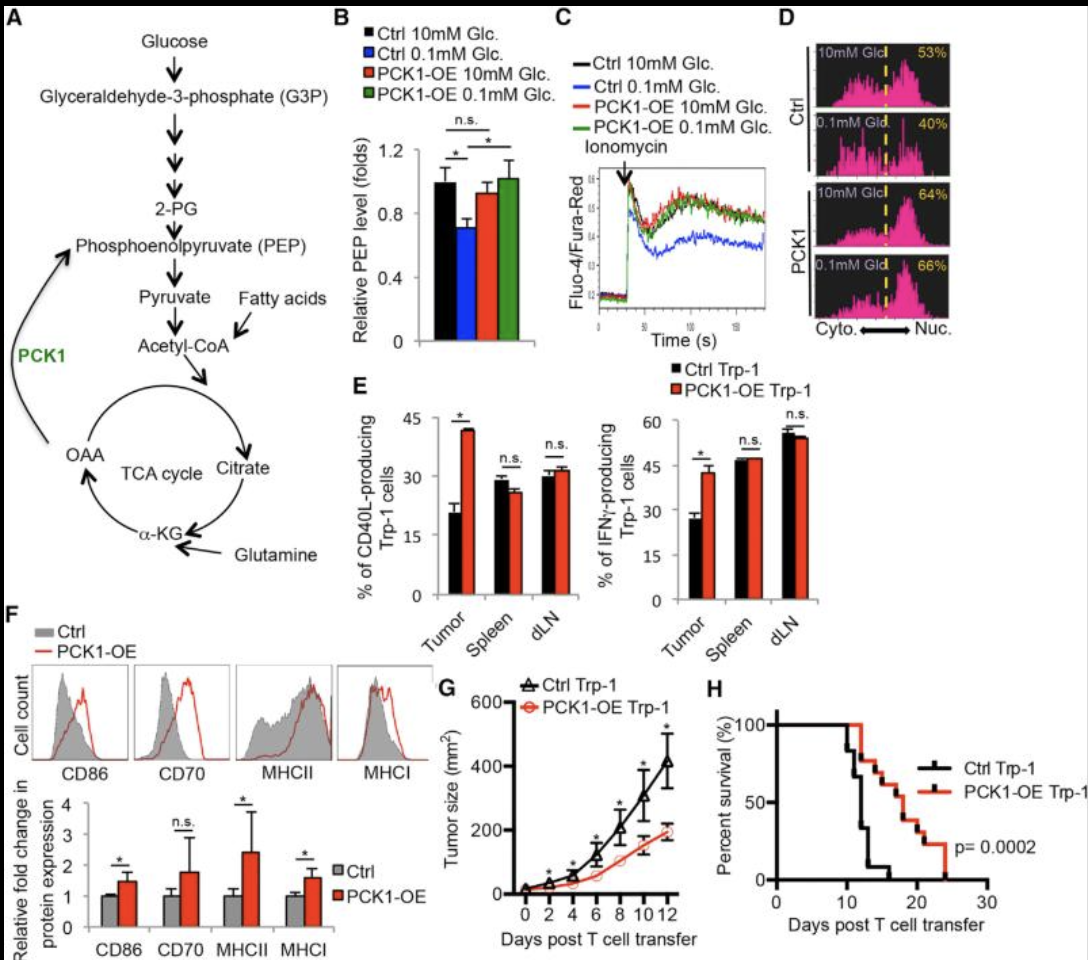
The authors studied T cells under nutrient-restricted conditions and looked for metabolic changes associated with impaired function. PEP emerged as one of the critical metabolites that dropped when glucose was limited.
They then linked low PEP to altered calcium handling and weaker NFAT activity. Mechanistically, the idea is that reduced PEP affects the cell’s ability to sustain the signaling architecture needed for full activation.
The engineering step is what makes the paper especially memorable. Rather than stopping at description, the authors increased intracellular PEP by expressing phosphoenolpyruvate carboxykinase 1, or PCK1, in T cells. That intervention helped restore function and improved antitumor responses in their models.
That is a very satisfying experimental arc. First define the deficit, then engineer around it.
What’s New?
The novelty is not merely that metabolism matters for T cells. That was already known.
The new thing is the level of specificity. This paper argues that one metabolite can tune immune-cell signaling in a direct, mechanistically meaningful way. That makes metabolism feel less like a bulk state and more like a control surface.
It also has a strong engineering implication. If one metabolic node can be adjusted to improve T-cell performance, then metabolism becomes something we can rationally design around rather than just measure after the fact.
My Interpretation
To me, this paper is exciting because it shrinks the problem to a manipulable scale.
It is easy to say “the tumor microenvironment is metabolically hostile.” It is harder, and much more useful, to say “this particular shortage causes this particular signaling failure, and here is one way to compensate.”
That is where the paper starts to feel like a bridge between basic immunology and cell therapy engineering. If PEP helps preserve calcium-NFAT signaling in stressed T cells, then engineered control of PEP might be a real design strategy for adoptive therapy.
I also like that the paper quietly challenges a common assumption. We often talk like signal transduction is the serious biology and metabolism is the support staff. This work flips that. A metabolite is directly shaping the signal.
What I’d Do Next
I would want to know how generalizable the PEP effect is.
Does this mechanism hold across different T-cell states, tumor types, and nutrient stresses, or is it strongest in specific contexts?
I would also want to know what the tradeoffs are. If you push T cells toward higher intracellular PEP, do you improve persistence long term, or do you create another kind of stress? The best cell-therapy engineering usually solves one bottleneck without creating a new one.
And importantly, I would want to test this alongside other known stressors in solid tumors, especially hypoxia, lactate accumulation, and chronic antigen exposure. Low glucose rarely exists by itself in real tumors.
Something I Learned
This paper made me think more carefully about the difference between “metabolism supports function” and “metabolism encodes function.”
That is a bigger difference than it first sounds. In the first version, metabolites are fuel. In the second version, metabolites are information.
I think this study lives in the second category, and that is why it stuck with me.
My Favorite Figure
References
- Ho PC, Bihuniak JD, Macintyre AN, Staron M, Liu X, Amezquita R, et al. Phosphoenolpyruvate Is a Metabolic Checkpoint of Anti-tumor T Cell Responses. Cell. 2015.