CancerBiology
The Moment p53 Became a Tumor Suppressor
There are some papers where the result feels less like a small experimental finding and more like a change in how people are supposed to think. Bert Vogelstein’s work on p53 is one of those moments. Today, p53 is one of the most famous genes in cancer biology. It is taught as the “guardian of the genome,” the cellular decision-maker that helps determine whether a damaged cell should pause, repair itself, or die. But that was not always obvious.
For a while, p53 was confusing. It was seen in cancer cells, associated with tumors, and originally thought by many to act more like an oncogene. That makes sense at a surface level. If you keep finding a protein in cancer, it is tempting to assume it is helping the cancer. But the key shift in this paper was realizing that the p53 found in cancer was often broken. The cancer was not using normal p53 as an accelerator. It was disabling p53 as a brake.
The Problem
Cancer is not just uncontrolled growth in a vague sense. It is growth after the cell has escaped multiple layers of control. A normal cell has systems that check DNA damage, regulate division, and prevent dangerous clones from expanding. If those systems fail, a cell can keep dividing when it should stop.
By the late 1980s, researchers already knew that many colorectal cancers had deletions on the short arm of chromosome 17. The problem was figuring out what those deletions meant. A chromosome deletion is like seeing a burned-out section of a city from above. You know something important might have been destroyed, but you still need to know which building mattered.
The question was: what gene on chromosome 17 was being lost, and why did that matter for colorectal cancer?
p53 became a strong candidate because the TP53 gene sits on chromosome 17p. But the bigger conceptual question was even more important: was p53 promoting cancer, or was cancer getting rid of p53?
Background Science
The difference between an oncogene and a tumor suppressor is one of the most important ideas in cancer biology.
An oncogene is like a stuck gas pedal. One bad copy can be enough to push growth forward. A tumor suppressor is more like a brake system. Usually, cancer has to damage both copies to fully remove the protection. This is often called the “two-hit” model: one allele can be deleted, and the other can be mutated.
That is why chromosome loss is so important. If a tumor repeatedly loses the same chromosomal region, it suggests that something in that region was preventing cancer. The cell gains an advantage by removing it.
For p53, this was especially interesting because p53 had a strange history. It had been found in cancer contexts and associated with viral transformation, so it was not immediately clear whether it was a cancer-promoting gene or a cancer-preventing gene. The answer depended on whether tumors were activating p53 or inactivating it.
This paper helped answer that.
What They Did
The authors studied colorectal carcinomas and compared tumor DNA to normal DNA from the same patients. This is the key design. Cancer genetics becomes much more powerful when you can ask, “What changed in the tumor that was not present in the normal tissue?”
They looked for deletions on chromosome 17, especially the region containing p53. Then they examined the remaining p53 gene to see whether it was normal or mutated.
The logic was beautiful:
If one copy of chromosome 17p is deleted and the remaining p53 copy is mutated, that would strongly suggest p53 is being inactivated.
That is very different from saying “p53 is present in cancer.” It says cancer is selecting for cells that have lost normal p53 function. The deletion removes one copy. The mutation damages the other.
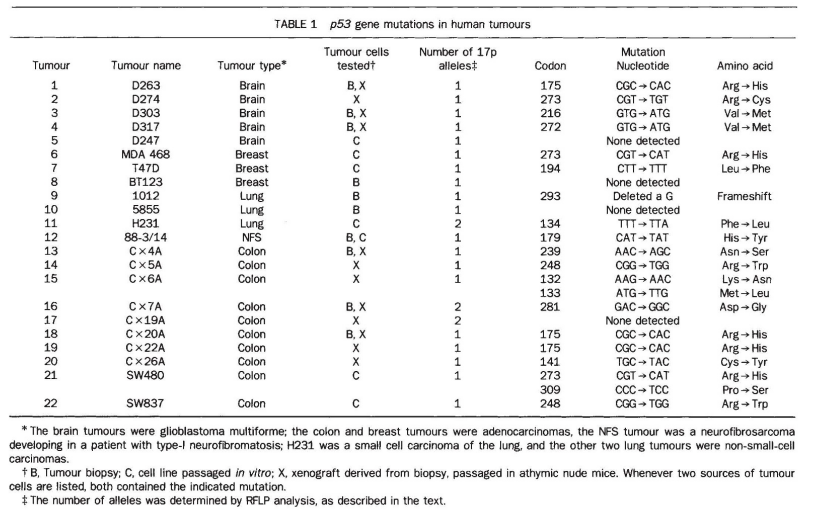
The paper found that chromosome 17 deletions and p53 mutations appeared together in colorectal cancers. That pattern fit the tumor suppressor model much better than the oncogene model.
What’s New?
The new idea was not just that p53 was involved in cancer. The important idea was how.
This paper helped show that p53 behaves like a tumor suppressor gene in human colorectal cancer. Cancer cells were not simply overusing p53. They were losing normal p53 activity through a combination of chromosomal deletion and mutation.
That is a huge conceptual shift. It turned p53 from a suspicious cancer-associated protein into one of the central protective systems that cancer must overcome.
It also strengthened a broader model of colorectal tumorigenesis. Vogelstein’s work helped frame cancer as a stepwise genetic process. Tumors do not appear all at once. They evolve through a sequence of genetic changes that allow cells to grow, survive, invade, and eventually become malignant. In that story, p53 loss is often a late and dangerous step because it removes a major checkpoint against genomic instability and abnormal survival.
My Interpretation
What I like about this paper is that it feels simple in the best way. It is not trying to explain every function of p53. It is not mapping every downstream pathway. It is asking a clean genetic question: if this gene matters, what is cancer doing to it?
And the answer is powerful because it comes from the tumor itself. The cancer is basically telling you what it needs. It deletes one copy of chromosome 17p and mutates the other p53 allele. That pattern is hard to ignore.
This is also a good reminder that biology can be misleading when you only look at association. p53 was associated with tumors, but the meaning of that association was not obvious. A protein showing up in cancer does not necessarily mean it is helping cancer. It might mean the cancer has altered it, stabilized it, or left behind a mutant version that no longer does its real job.
That distinction matters a lot. In cancer biology, the question is not just “what genes are present?” It is “what function has been gained or lost, and why would that help the tumor?”
For p53, the answer became one of the most important in the field: cancer benefits when it loses the cell’s ability to respond properly to damage.
What I’d Do Next
If I were reading this paper at the time, the obvious next question would be: what does normal p53 actually do?
This paper makes a strong genetic argument that p53 suppresses tumorigenesis, but it does not fully explain the mechanism. So the next steps would be to ask:
What genes does p53 regulate?
Does p53 stop the cell cycle after DNA damage?
Does p53 induce apoptosis when damage is too severe?
Do different p53 mutations have different effects?
Why do some p53 mutant proteins accumulate in tumors?
Those questions became entire fields. Later work showed that p53 functions as a transcription factor and controls programs related to cell-cycle arrest, DNA repair, senescence, and apoptosis. That makes the tumor suppressor model even more satisfying. If p53 is the protein that helps a damaged cell decide whether to stop or die, then losing p53 gives a precancerous cell permission to keep moving forward when it should not.
I would also want to know when p53 loss happens during colorectal cancer progression. Is it an early event that starts tumor formation, or a later event that helps an adenoma become invasive? That question matters because it places p53 into the timeline of cancer evolution.
Something I Learned
The biggest lesson from this paper is that cancer genes are not just “on” or “off” in a simple way. You have to think about selection.
A tumor is an evolving population of cells. If a mutation keeps appearing across tumors, it probably gives those cells an advantage. The job is to figure out what advantage that is.
In this case, the advantage was not faster growth from activating p53. It was escape from normal control by losing p53. That is such an important distinction.
I also think this paper shows why human tumor samples are so valuable. Cell lines and model systems are useful, but there is something uniquely convincing about looking directly at patient tumors and seeing the same genetic pattern repeat itself. It makes the biology feel less abstract. These are not just pathways on a diagram. These are real evolutionary scars inside real cancers.
My Favorite Figure
References
-
Baker SJ, Fearon ER, Nigro JM, Hamilton SR, Preisinger AC, Jessup JM, VanTuinen P, Ledbetter DH, Barker DF, Nakamura Y, White R, Vogelstein B. Chromosome 17 deletions and p53 gene mutations in colorectal carcinomas. Science. 1989;244(4901):217-221.
-
Nigro JM, Baker SJ, Preisinger AC, Jessup JM, Hostetter R, Cleary K, Bigner SH, Davidson N, Baylin S, Devilee P, Glover T, Collins FS, Weston A, Modali R, Harris CC, Vogelstein B. Mutations in the p53 gene occur in diverse human tumour types. Nature. 1989;342:705-708.
-
Vogelstein B, Fearon ER, Hamilton SR, Kern SE, Preisinger AC, Leppert M, Nakamura Y, White R, Smits AMM, Bos JL. Genetic alterations during colorectal-tumor development. New England Journal of Medicine. 1988;319:525-532.