CancerBiology
Why More Mutations Can Make a Tumor More Visible
One of the hardest questions in immunotherapy is why one patient responds beautifully while another does not. PD-1 blockade looked promising early on, but it was obvious pretty quickly that not all tumors were equally sensitive. The Rizvi et al. paper is one of the studies that made that problem feel genetically tractable. It asked whether the mutational landscape of non-small-cell lung cancer could help explain who benefits from PD-1 blockade.
The Problem
Checkpoint inhibitors do not create an immune response out of nowhere. At some level, they rely on an immune response being possible.
That means a tumor probably needs to be immunologically visible enough for reinvigorated T cells to recognize it. One plausible source of that visibility is mutation-derived neoantigens. If a tumor carries lots of nonsynonymous mutations, it may generate more abnormal peptides that the immune system can treat as foreign.
The question is whether that relationship shows up in actual patients treated with PD-1 blockade.
Background Science
Lung cancers, especially smoking-associated tumors, often carry relatively high mutational burdens. That made NSCLC a logical place to test the neoantigen hypothesis.
Before this paper, the idea that a more mutated tumor might respond better to checkpoint blockade was already floating around, but it was not yet cemented in a clinically persuasive way. Biomarker thinking was still heavily focused on PD-L1 staining and simple clinical categories.
This study helped broaden that view by putting tumor genomics into the response equation.
What They Did
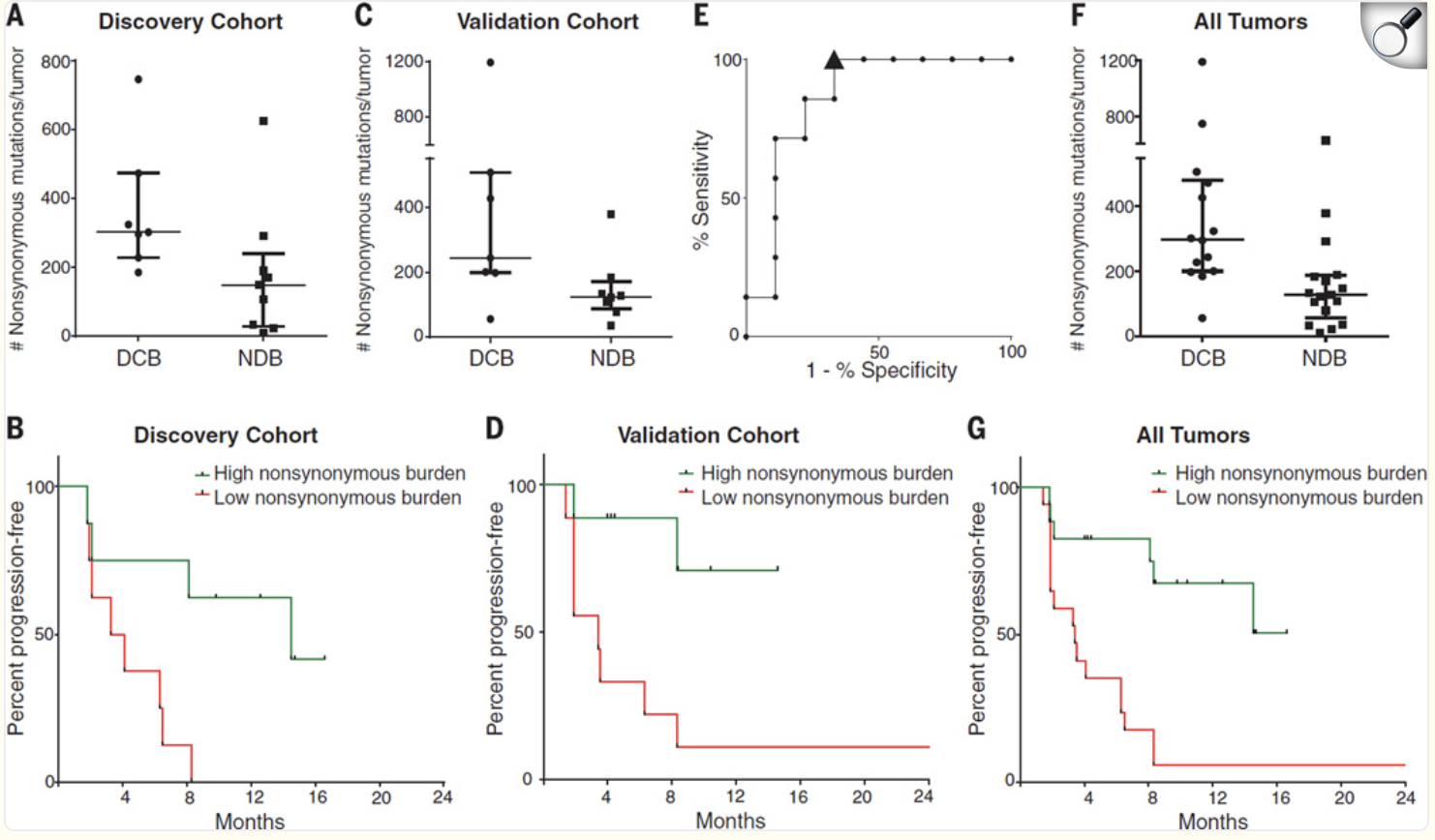
The authors analyzed patients with NSCLC treated with PD-1 blockade and integrated clinical outcomes with genomic sequencing data. They looked at nonsynonymous mutation burden and asked whether it associated with objective response, durable clinical benefit, and progression-free survival.
The answer was yes. Patients whose tumors carried higher mutational burdens were more likely to benefit. The paper also connected certain mutational signatures and DNA repair-related features with sensitivity, which made the story even more biologically coherent.
That is what I appreciate about the study. It did not stop at “more mutations good.” It started to ask what kind of mutational history makes a tumor more immunologically targetable.
What’s New?
The main advance is that this paper made checkpoint response prediction feel partly genomic.
That sounds normal now because tumor mutational burden has become such a familiar concept, but in 2015 this was a real shift. It suggested that sequencing a tumor could tell you something meaningful about immunotherapy sensitivity.
It also helped connect basic cancer genetics to immuno-oncology more tightly. Mutations were not only drivers of growth. They were also potential sources of immunologic visibility.
My Interpretation
What I find compelling about this paper is that it explains response without making the immune system feel mystical.
Sometimes immunotherapy gets discussed like a black box. Some tumors are inflamed, some are cold, some respond, some do not. This paper adds structure. It says that one reason a tumor might respond is that its mutational history has created enough foreignness for T cells to see, once PD-1 is blocked.
Of course, this is not the whole story. Plenty of high-mutation tumors do poorly, and some lower-mutation tumors still respond. But the paper gave the field a durable principle: antigenic opportunity matters.
I also like how this paper fits with the broader immunology story. Checkpoint blockade works best when it is releasing brakes on an immune response that has something real to grab onto.
What I’d Do Next
The next obvious step is refinement.
Not all mutations are equal, so I would want to distinguish raw mutational burden from true neoantigen quality. Which mutations are actually processed, presented, and immunogenic?
I would also want better integration with non-genomic factors. A high-TMB tumor that excludes T cells or lacks antigen presentation may still fail. So the real biomarker framework probably needs genomics plus microenvironment plus immune state.
And because the field has moved toward composite biomarkers, this paper still points toward an unfinished challenge: predicting response with something better than one number.
Something I Learned
The thing I learned most from this paper is that cancer genomics and immunotherapy are not parallel stories. They are the same story from different angles.
A mutation can drive growth, but it can also create vulnerability. That is such a satisfying idea because it means the evolutionary chaos that helps a tumor survive can also make it more visible to the immune system.
My Favorite Figure
References
- Rizvi NA, Hellmann MD, Snyder A, Kvistborg P, Makarov V, Havel JJ, et al. Mutational Landscape Determines Sensitivity to PD-1 Blockade in Non-Small Cell Lung Cancer. Science. 2015.